

Dim Sum Palace
And an afternoon seeing Greater New York


I am having lunch at a Cantonese restaurant in Queens. It’s called Dim Sum Palace, a block or two past the Court Square subway station, in a building that used to be an Italian-American restaurant and bar, Brooks 1890. It really is like a dim sum parlor moved right into an American pub. There is something very New York about ordering a Tsingtao and Sichuan cucumbers next to vintage Budweiser wall signs.
Just a few blocks away is MoMA PS1. It started in 1976 in an old public school building and became an affiliate of the Museum of Modern Art in 2000. It really is like a museum moved right into a school. They kept the graffiti on the stairwells, the long hallways, the classroom-sized rooms.
The last time I visited I was still a student at the Fashion Institute of Technology, interning for a writer at the New York Times, handing out flyers at a PS1 Warm-Up party. Social marketing in the 2010s. Today I was first in line when it opened at noon, and I had the place to myself, which was lovely until the third time a guard told me I was standing too close to the artwork. I was the only one for them to look at.
Every five years, or a quinquennial in art speak, MoMA PS1 puts on Greater New York, a show of artists living and working here right now. This is the sixth edition, 53 artists and collectives who call New York City home. Most are on the younger side, and many came from somewhere else.
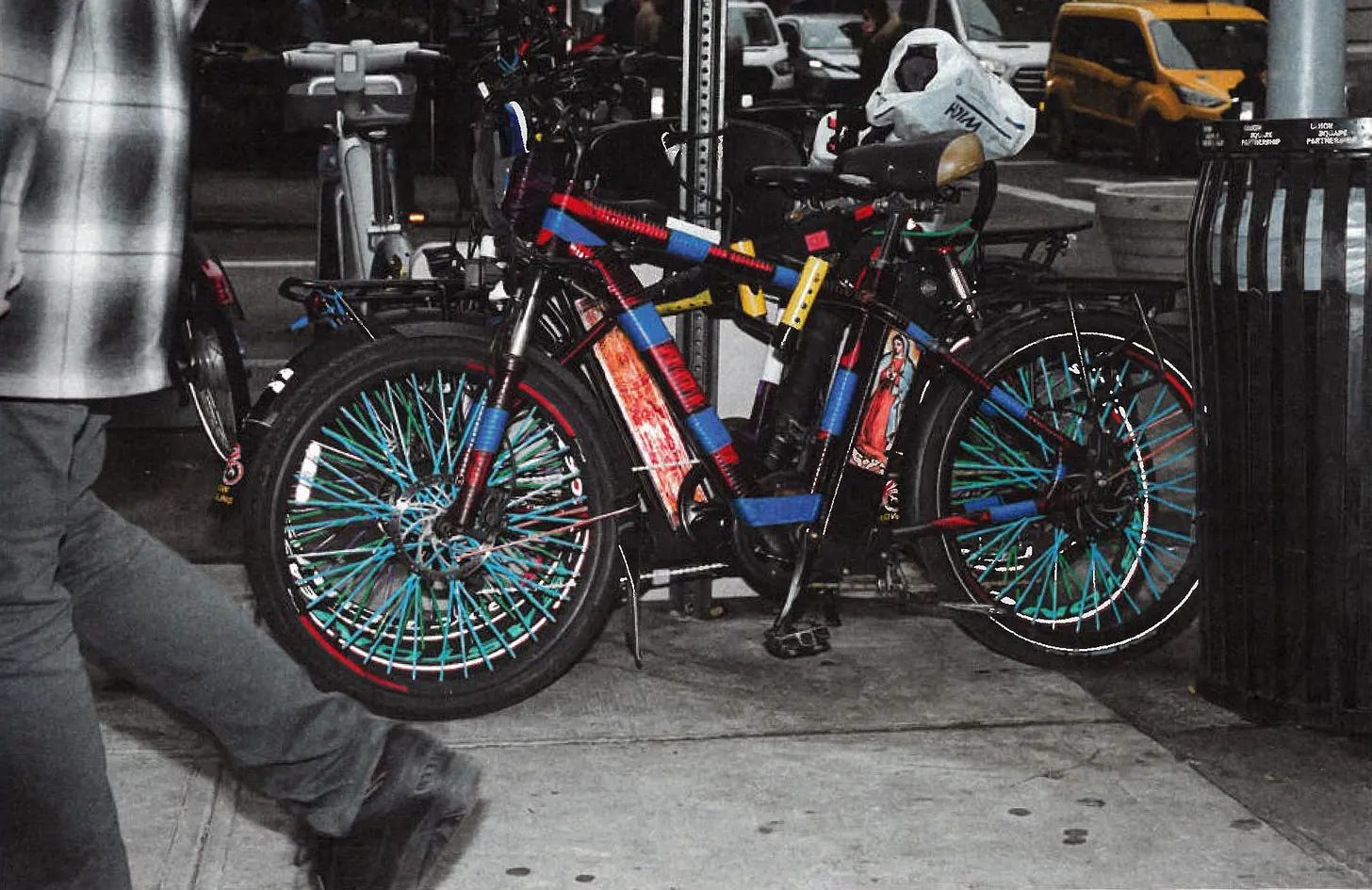
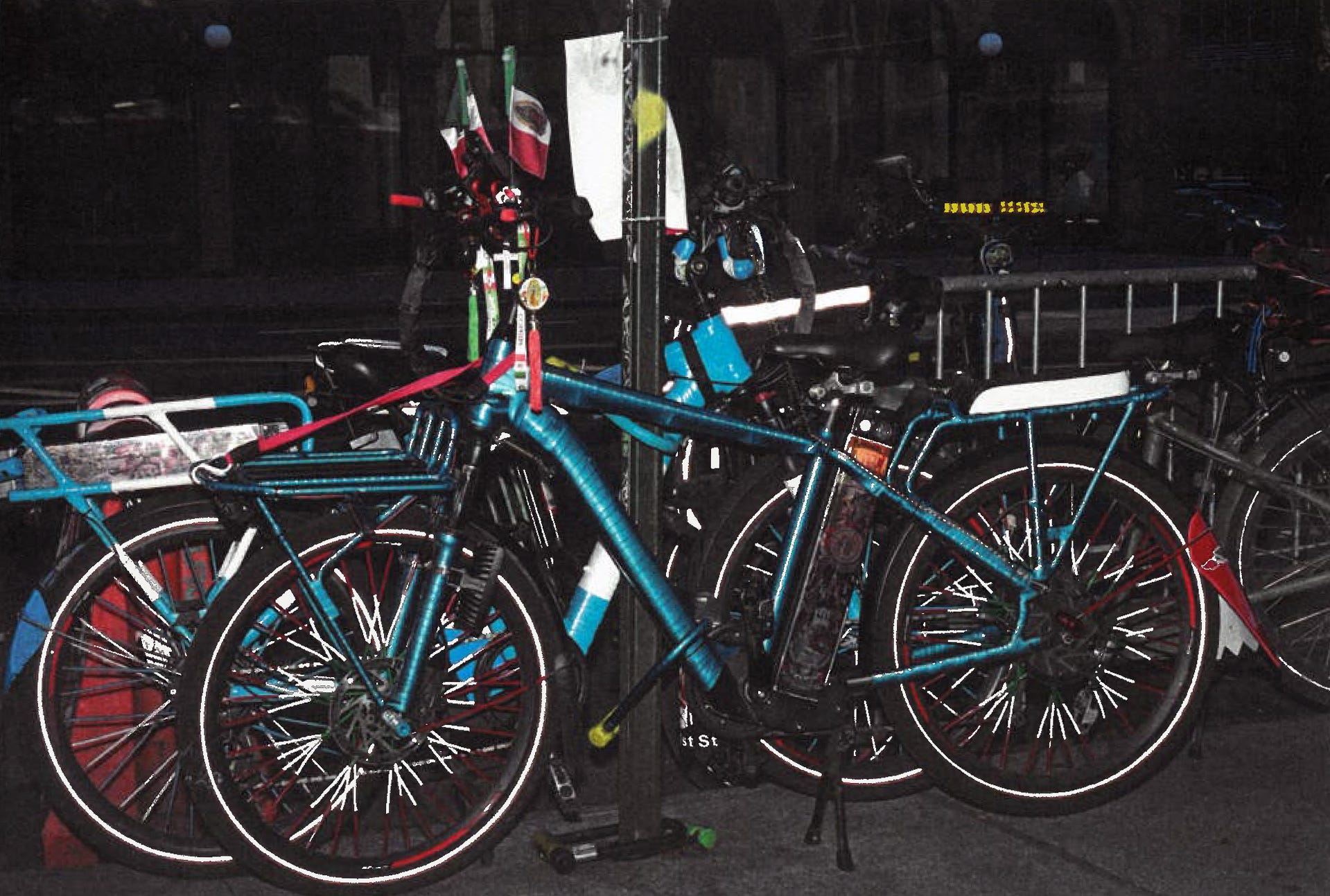
fields harrington is from Sacramento. He created a series of photographs of electric delivery bikes parked on the street. The number of delivery workers here has nearly doubled since 2019, and the apps pay them to go as fast as they can. It is one of the most dangerous jobs in the city. harrington photographs the bikes but never the riders, to protect them, since many are undocumented. Up close, you can see what each rider has done to make it theirs. Metallic tape wrapped around the frame, a flag from home, a Virgin Mary sticker on the battery pack, the outline of Africa. I see these bikes every day and I have never once stopped to look at them this way.
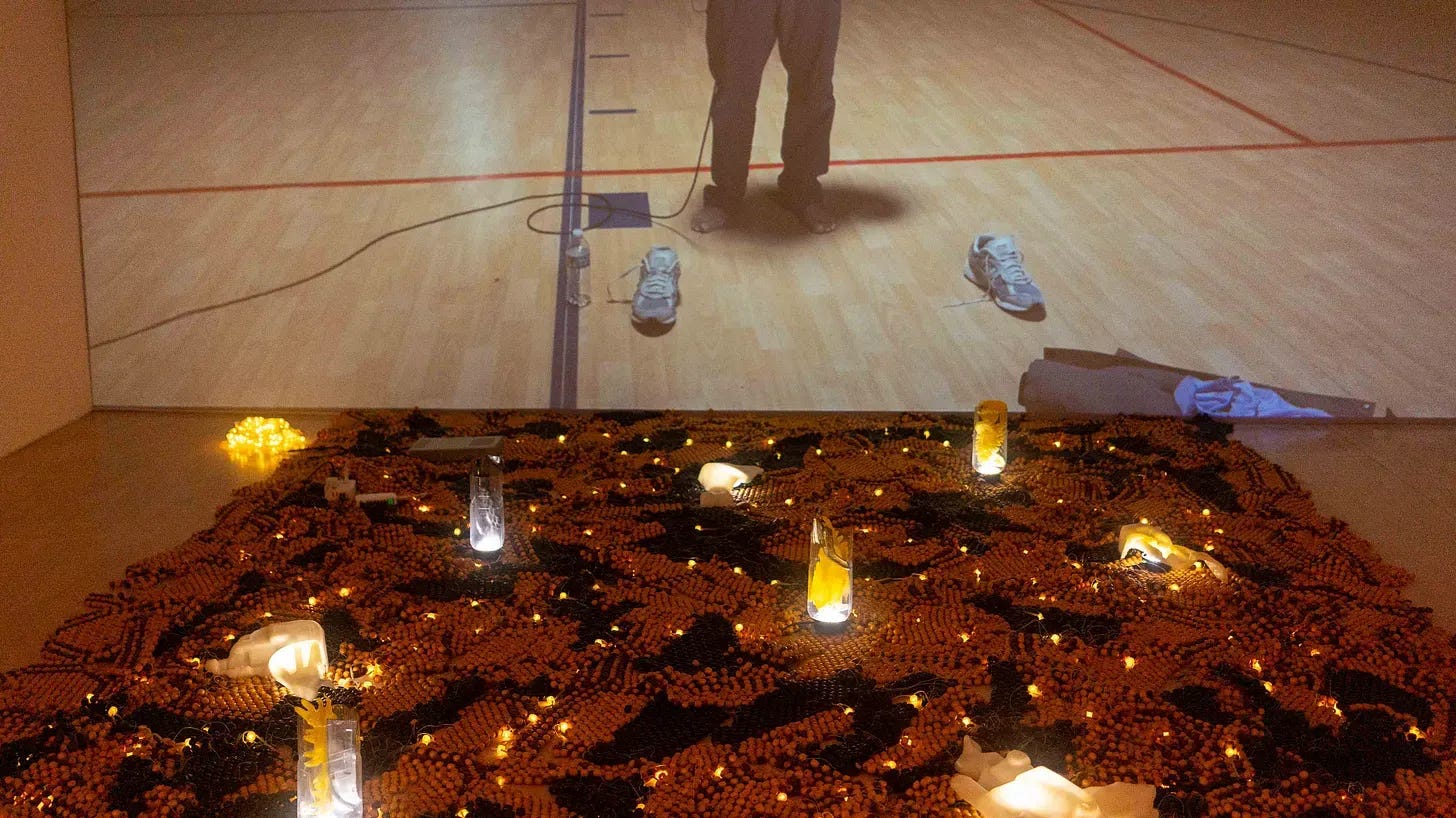
Kenneth Tam is from Queens, born there in 1982. His piece is called I’m Staying Hopeful and Strong (For Bilal and Salah), and it came out of the time he has spent with taxi drivers ruined by the medallion crisis. The medallion was sold to immigrant families as a guaranteed route to the middle class, and then came deceptive dealing, predatory lending, deregulation, and debts near a million dollars. His video is of two brothers, Bilal and Salah, Lebanese cab drivers in their sixties, moving through a slow kind of dance in an empty gym, saying words they wrote themselves about the work they do. It is projected above a sculpture on the floor made of the wooden beaded seat covers any New Yorker would recognize, laid out like a rug and lit with blinking LEDs like the skyline
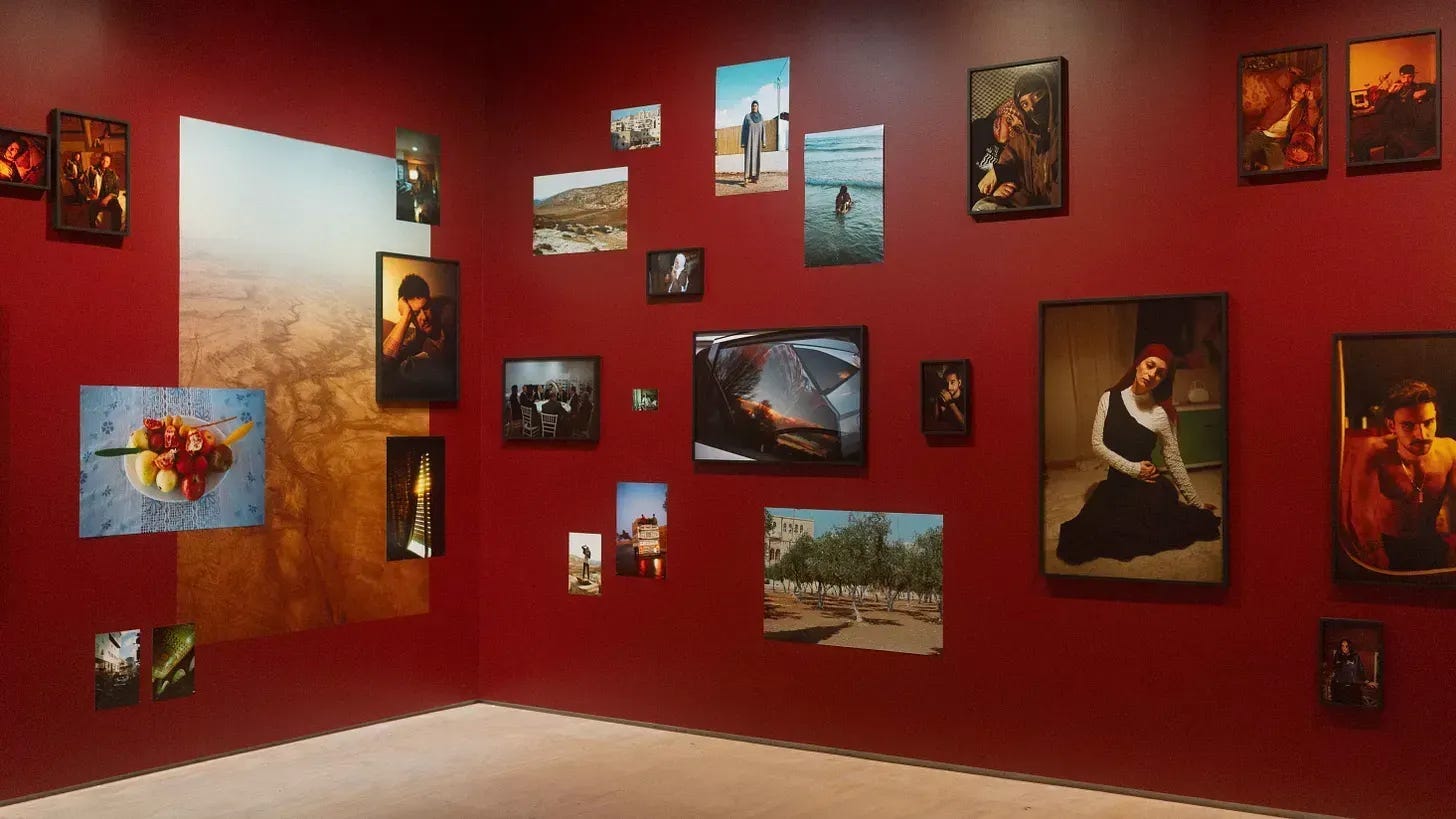
Dean Majd is also from Queens, born there in 1990 to Palestinian immigrant parents. His series Birthmark is portraits of the Palestinian diasporic community in New York, many of his own generation, creatives and artists, photographed in their homes. The most recognizable is Mahmoud Khalil, the Columbia student, home from an ICE facility, holding his newborn next to his wife. I had seen it on the cover of Dazed. They hang with another body of work, Separation, taken in 2018 on his first trip to Palestine, traveling with his mother and meeting relatives for the first time.
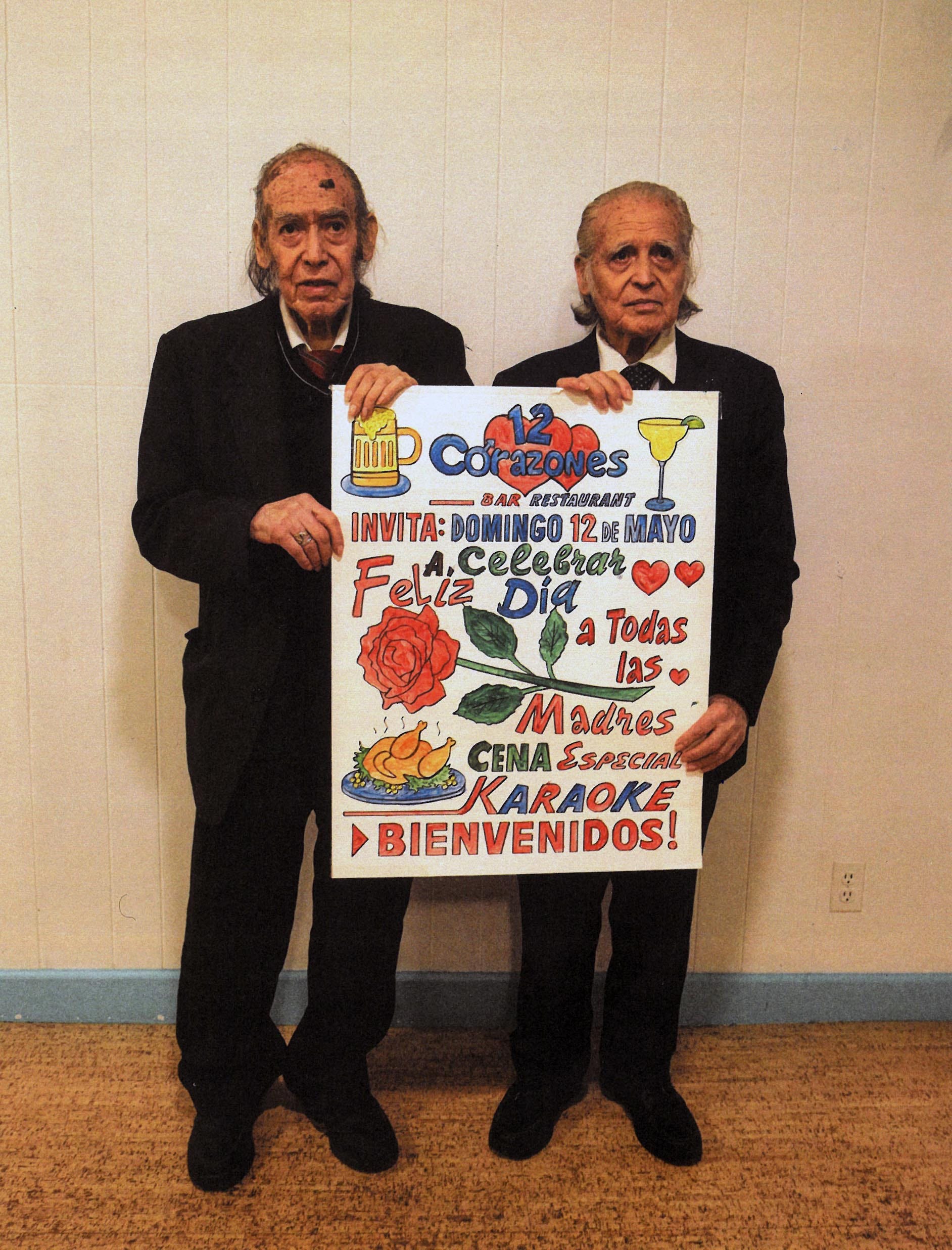
The Cevallos Brothers, Carlos and Miguel, are in their eighties, the oldest artists in the show. They grew up in Bogotá, where they ran a sign shop in the sixties. Carlos came to New York first, painting signs in a Times Square studio, and then out in Queens they found the Colombian and Ecuadorian business owners along Roosevelt Avenue, under the 7 train in Jackson Heights. They have hand-painted the posters for the bodegas and taco trucks and restaurants ever since, Miguel doing the lettering, Carlos doing the color. They take commissions on their Instagram now.
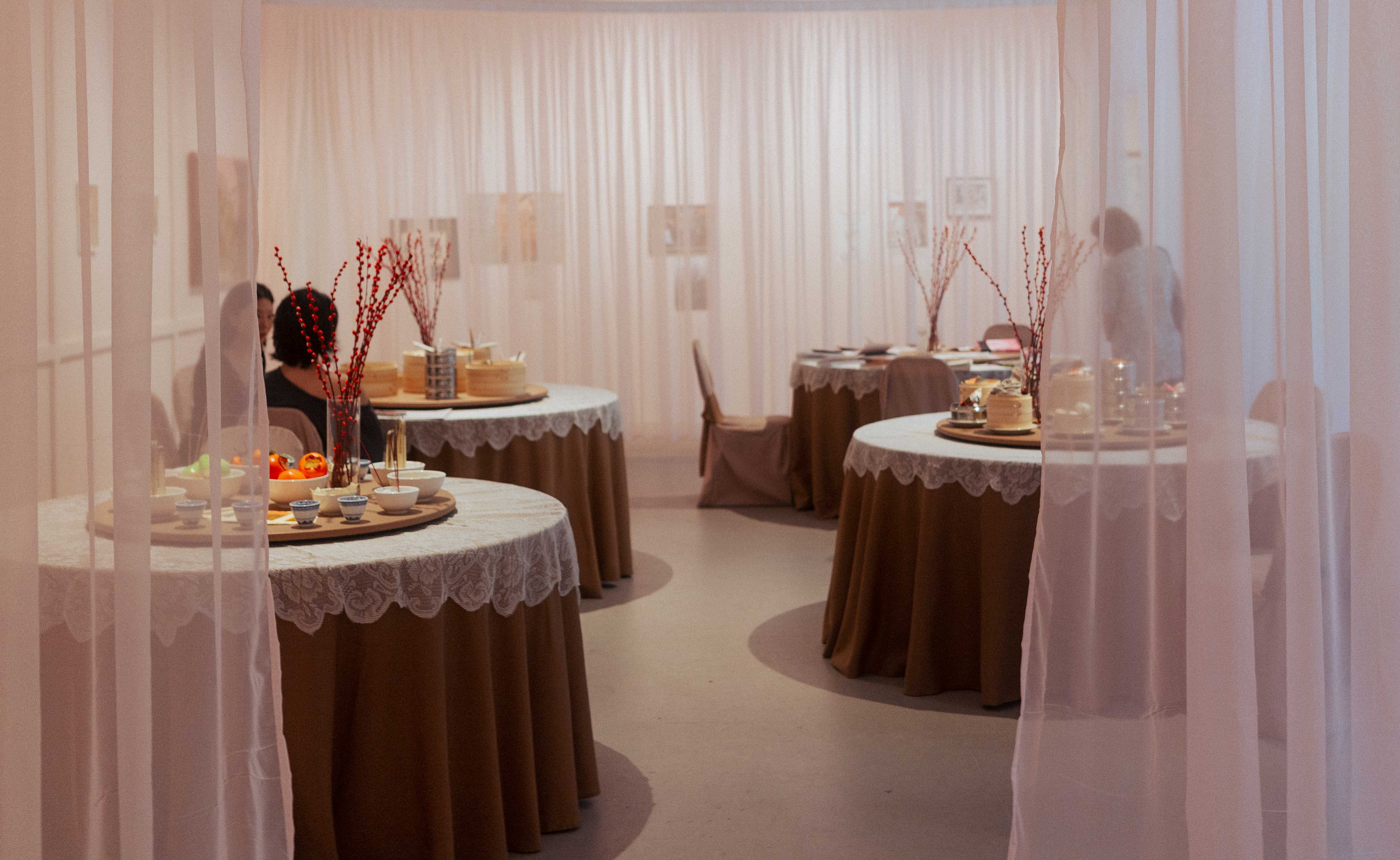
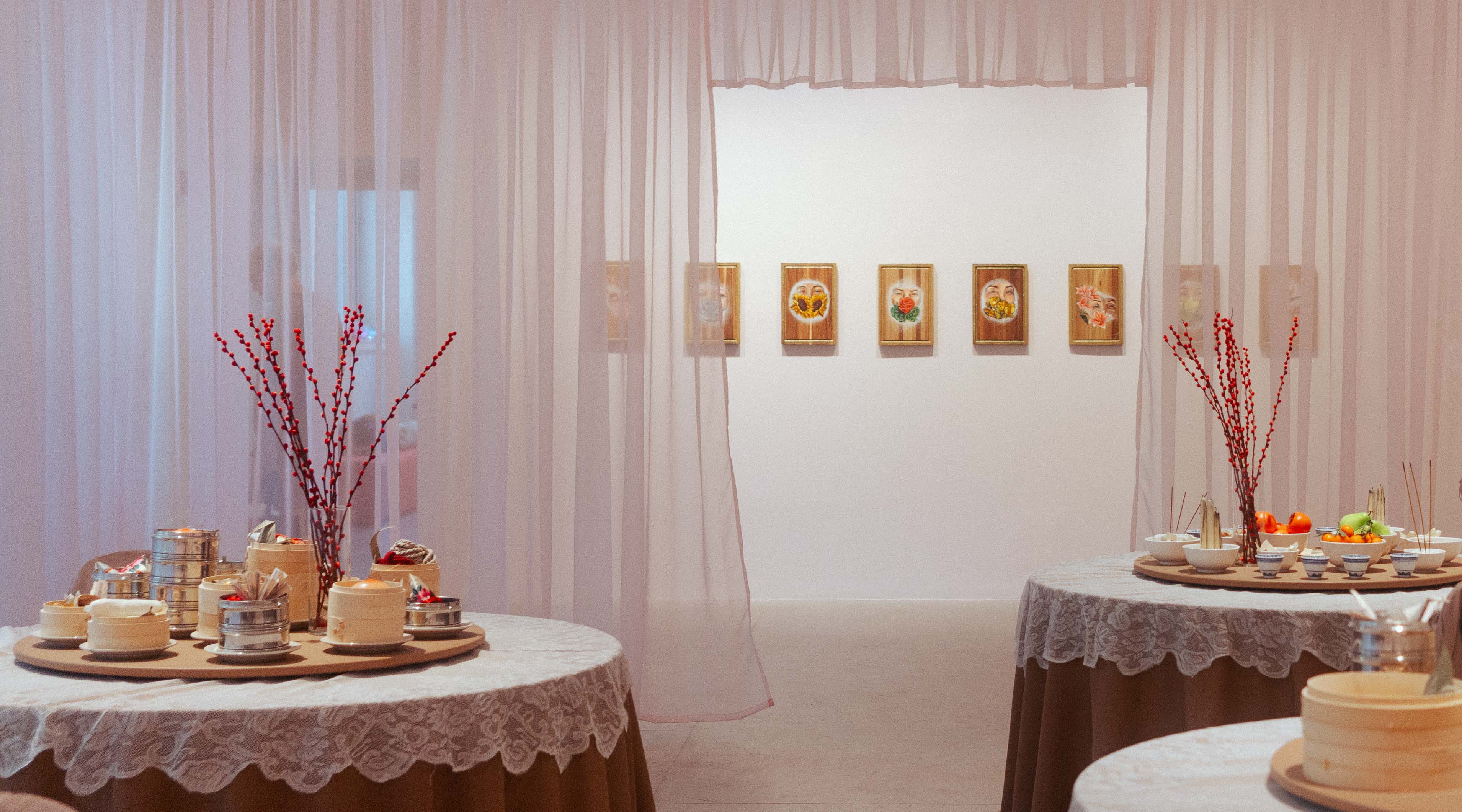
Red Canary Song is a Flushing collective of migrant massage workers, sex workers, and allies across the Asian diaspora. It formed in 2017, after Yang Song, a Chinese massage worker, fell to her death during a police raid on the parlor where she worked. Their piece is called Touch the Heart, which is what dim sum means in Cantonese. They built a dim sum restaurant inside the museum, pink curtains, round banquet tables set with bowls and chopsticks, each table a different part of their work. On the walls are portraits of workers who have died, painted by a Korean massage worker named Ellen. The dim sum table is where the organization actually gathers, where they serve comfort food and hand out resources.
Eating lunch with me this afternoon at Dim Sum Palace is a young mother and her son, about three. I think they are the waiter’s family, by the way they talk to each other in a language I don’t understand. She keeps picking things off her plate and putting them on his. At the next table, a Spanish couple in their seventies, their adult son ordering the Peking duck, talking to them in Spanish and then turning to order in English. I have watched my wife do this a hundred times for her Polish family. A girl who looks Gen Z, striped hair like Alysa Liu, splitting fried rice with a boy in a tie-dye shirt. An elegant Asian woman about my mother’s age at a table for one, three steamer baskets in front of her, taking her time. A middle-aged Indian man in a sharp suit eats fast, like he is late for a meeting. An older Asian man in glasses leans over the bar to show the bartender something in the newspaper, and the two of them laugh. He leaves and says see you tomorrow. Must be a regular. Five businessmen with strong New York accents order another round of beers from the bartender, who answers in a heavy Cantonese accent. An American country song is playing. I order another round of pork dumplings to finish off my Tsingtao.
The TV over the bar is on, the local news. There is an update from the NYPD on the attack outside 26 Federal Plaza, the government building in Lower Manhattan where ICE has offices and immigrants get arrested at their check-ins. It's on mute.
A delivery driver comes in, shows the bartender an order on his phone, takes the bag, and rides off on his e-bike.
Greater New York closes August 17th.